
Half Your House Lost Power? The "Lost Leg" Problem Explained
When some rooms go dark, the AC blows warm air, and the dryer won't heat, you've probably lost one of the two legs of power feeding your home. Here's what to do.
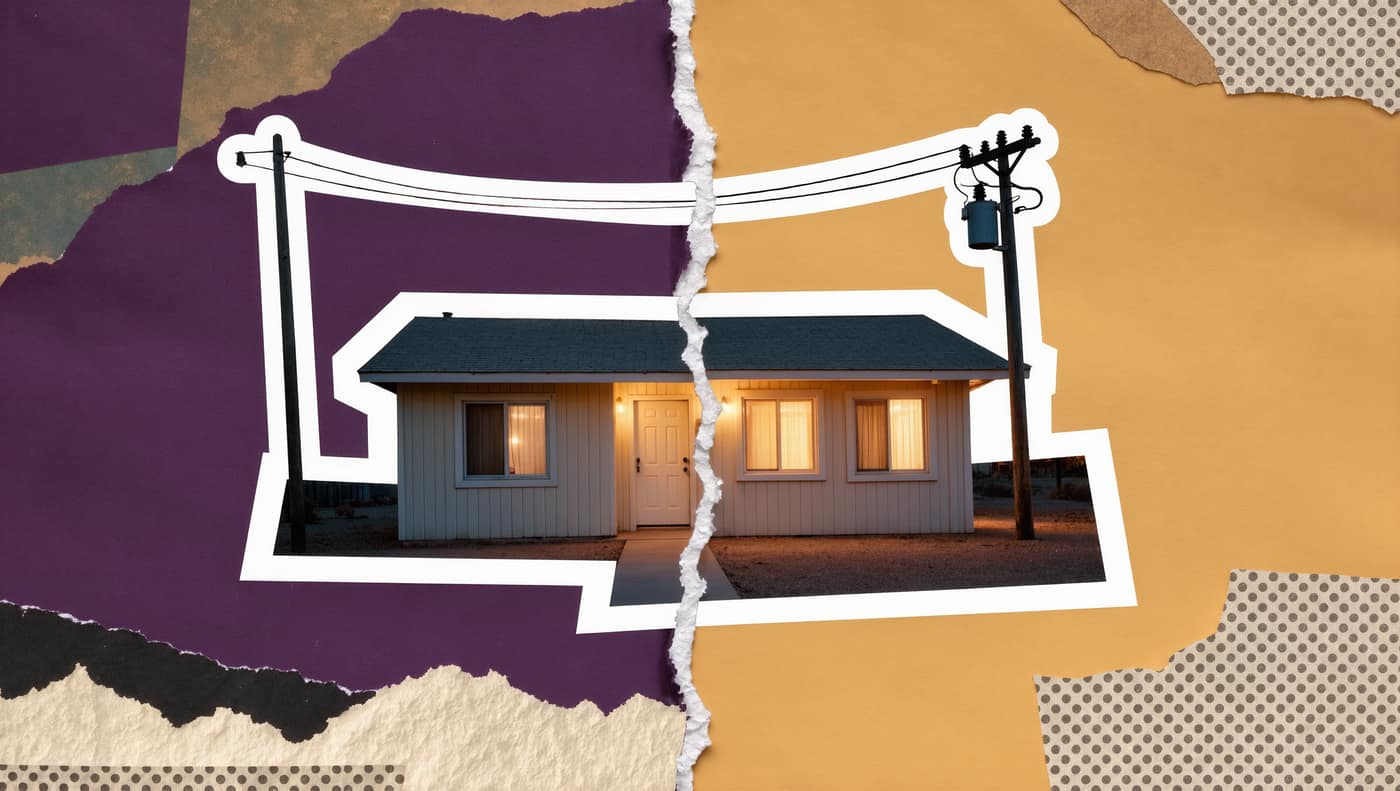
If half your house suddenly has no power while the other half works fine, you've most likely lost one "leg" of your electrical service. Homes are fed by two 120-volt legs that combine to make 240 volts. Lose one, and every circuit on that leg goes dead. Big 240-volt appliances like the AC, the dryer, and the range either stop working or run strangely.
The cause is usually outside the home, at the utility's transformer or service line. Sometimes it's at your meter or main breaker. Either way, there are a few things to check and one important thing to turn off.
Signs You've Lost a Leg
Roughly half of the rooms, lights, or outlets are dead, but the others work normally.
The AC's indoor fan blows, but the air is warm because the outdoor compressor won't start.
The dryer tumbles but won't heat, or the electric range and oven won't heat.
Some lights glow dimly instead of being fully on or off.
Resetting the breakers doesn't bring anything back.
One warning: if lights are flickering bright and dim, or bulbs are suddenly much brighter than normal, that may be a lost neutral, not a lost leg. A lost neutral can send damaging high voltage to your electronics. Turn off the main breaker and call for emergency electrical service right away.
What to Do Right Now
1. Turn off the AC at the thermostat. A compressor trying to start on low or uneven voltage can damage itself. Switch off the dryer, range, water heater, and pool pump too.
2. Check the main breaker. Push it fully to OFF, then back to ON. A main breaker that has partly tripped or failed internally can drop one leg.
3. Check with a neighbor. If houses around you have the same problem, the issue is almost certainly on the utility side.
4. Call your utility. APS and SRP both handle partial outages. Report that you have partial power and suspect a lost leg. Utility-side repairs, like a blown transformer fuse or a failed service connection, are the utility's job and cost you nothing.
5. If the utility says their side is fine, call an electrician. The problem is then at your meter base, your main breaker, or the service conductors on your home, and it needs a licensed electrician.
Lost Leg, Tripped Breaker, or Full Outage?
These three problems look alike at first, so here's how to tell them apart quickly.
Tripped breaker: one room or one group of outlets is dead, and the breaker for that circuit sits in the middle or OFF position. Resetting it brings power back. Our guide to a breaker that keeps tripping covers what to do if it won't stay on.
Lost leg: about half the circuits across the whole house are dead at once, the breakers all look normal, and 240-volt appliances act strangely. Resetting breakers changes nothing.
Full outage: everything is off, including the meter's display. Check your utility's outage map. There's nothing to fix on your side.
If you're not sure, treat it like a lost leg: turn off the AC and big appliances, and call your utility first.
What Causes a Lost Leg
Utility side: a blown fuse on the pole or pad-mounted transformer, a damaged overhead service drop after a monsoon wind, or a failed underground splice. Older underground connections in established Valley neighborhoods are a common culprit, especially after heavy rain.
Your side: a loose or burned lug in the meter base, a failing main breaker, or corroded service-entrance conductors. Decades of summer heat cycling loosen connections, and a loose connection under heavy AC load can overheat and burn open.
What a Repair Costs
If the utility finds the fault on their side, you pay nothing. If it's on your side, typical Phoenix-area ranges look like this. Tightening or replacing damaged connections in the meter base or panel usually runs $300 to $900. Replacing a failed main breaker typically runs $400 to $1,200, depending on the panel. Replacing a burned meter base or meter-main combination usually runs $2,000 to $4,500, including utility coordination.
When the meter-main is old or damaged, it often makes sense to replace it as part of a panel upgrade rather than patch it. We give you a written price before any work begins.
Help When It Can't Wait
A partial outage in a Phoenix summer is more than an inconvenience. It can take out your AC on a 112-degree afternoon. Our electrical repair team diagnoses lost legs and service problems, with 24-hour emergency response across the Valley. That includes Phoenix, Glendale, and Mesa.
Frequently Asked Questions
Is a lost leg dangerous?
The dead half is safe, but the situation isn't normal. Low or uneven voltage can damage motors in your AC, pool pump, and appliances. A burning connection at the meter can be a fire risk. Turn off big appliances and get it diagnosed promptly.
Can I fix a lost leg myself?
No. The meter base and service conductors stay energized even with the main breaker off, and only the utility can disconnect them. This is work for the utility or a licensed electrician.
Why does my AC blow warm air when half the house is out?
The indoor blower runs on 120 volts from the working leg, but the outdoor compressor needs 240 volts from both legs. With one leg missing, the fan runs and the compressor can't. Turn the AC off until power is restored.
The Takeaway
Half the house dead usually means a lost leg. Turn off the AC and big appliances, check the main breaker, call your utility first, and call an electrician if the problem is on your side of the meter.
Need a hand with this?
Electrical Repair
Keep Reading
How Much Does a Whole-Home Generator Cost in Phoenix?
Most Valley homeowners spend $9,000 to $18,000 for an installed standby generator. Here's what moves the number, and how to get AC-level backup without overbuying.
Read more
Breaker Keeps Tripping and Won't Reset? What It Means and What to Do Tonight
A breaker that trips the instant you reset it is telling you something specific. Here's how to read it, what you can safely try, and when to stop and call.
Read more
Electrical Panel Upgrade Cost in Phoenix: 100A vs. 200A (2026)
A same-size panel swap runs about $2,000–$4,000. Moving from 100 to 200 amps is usually $3,500–$6,500. Here's what you're paying for and how to tell which you need.
Read moreReady When You Are
Free estimates, upfront pricing, and licensed electricians who show up on time. Let's get it handled.