

Low Voltage vs. Line Voltage: Structured Cabling for Phoenix Businesses
Line voltage runs your lights and equipment. Low voltage carries your network, cameras, access control, and AV. Here's the difference, why it matters, and what a cabling project costs.
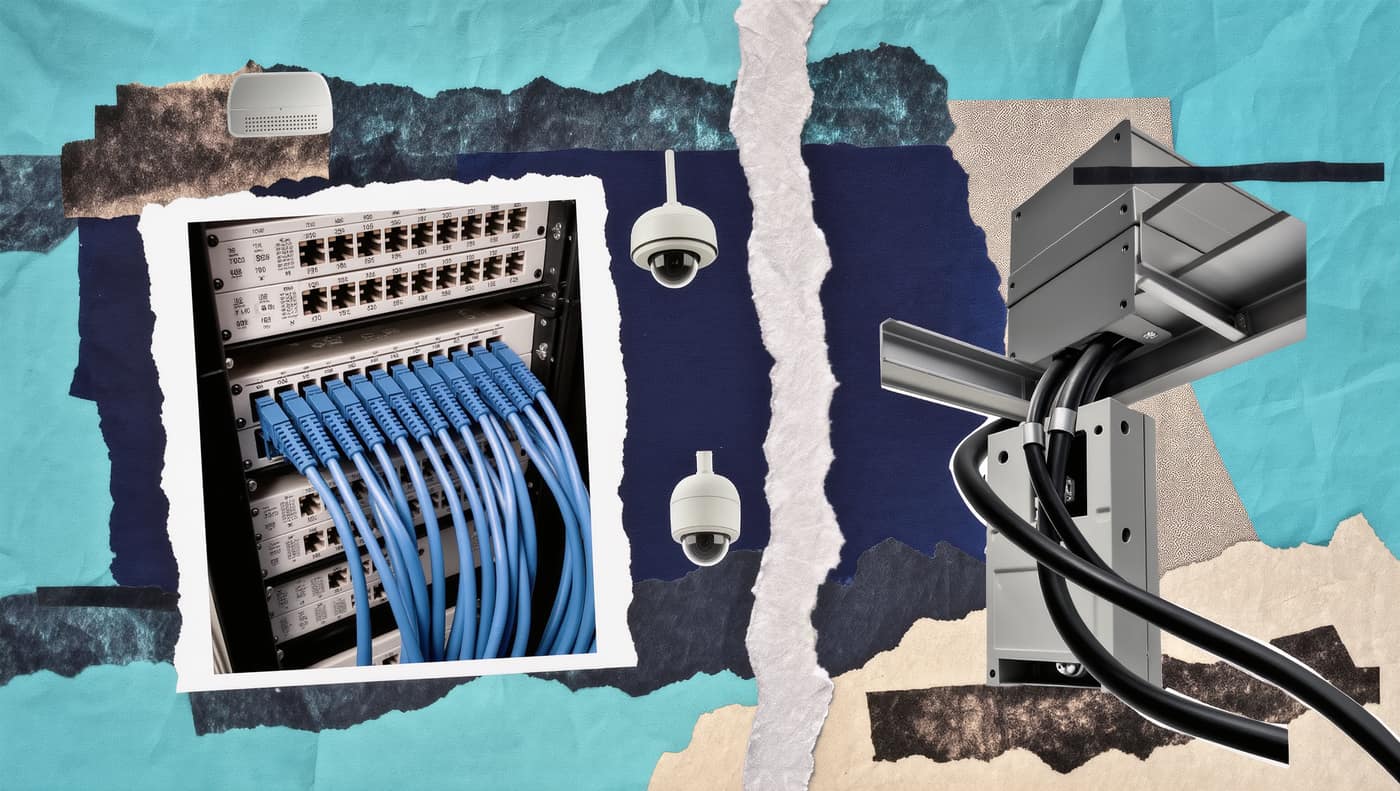
Line voltage is the power that runs your building: 120, 208, 277, and 480-volt circuits feeding lights, receptacles, HVAC, and equipment. Low voltage covers everything that carries signals or small amounts of power, generally under 50 volts. That means data cabling, Wi-Fi access points, security cameras, access control, paging, and AV.
The two run side by side in every modern commercial space, but they're designed, installed, and tested differently. Getting both right, and getting them to work together, is what keeps your network fast and your building reliable.
What Counts as Low Voltage
Structured data cabling: Cat6 and Cat6A copper to desks, printers, and access points, plus fiber backbones between floors and telecom rooms.
Power over Ethernet (PoE) devices: wireless access points, IP cameras, door readers, VoIP phones, and even some LED lighting. The network cable carries both data and power.
Security and access control: camera cabling, card readers, door strikes, and intrusion sensors.
AV and paging: conference room displays, speakers, and overhead paging.
These systems are governed by different code articles and installation standards than line voltage, and they have their own testing requirements.
Why the Difference Matters
Separation: low-voltage cable can't share a raceway or box with power conductors unless there's a listed barrier. Running data too close to power for long distances can also introduce interference. Planning the pathways together avoids rework.
Fire ratings: cable in return-air plenum ceilings, common across Phoenix office buildings, must be plenum-rated (CMP). Riser-rated cable goes in vertical shafts. The wrong jacket fails inspection.
Distance limits: a copper Ethernet channel tops out at 100 meters, about 328 feet, including patch cords. Larger floor plates need telecom rooms or fiber placed to keep every run inside that limit.
Testing: line voltage is checked for continuity and correct connections. Structured cabling should be certified on every run with a cable analyzer, with documented results that prove each drop meets its category rating.
Cat6 vs. Cat6A
Cat6 supports gigabit speeds to every drop and 10-gigabit over shorter runs. It's a solid, economical choice for most desk drops.
Cat6A supports 10-gigabit over the full 100 meters, handles heat from high-power PoE in large bundles better, and gives you more headroom for the next decade. It's the better choice for wireless access points, cameras, and anything running high-power PoE. Many businesses run Cat6 to desks and Cat6A to ceilings.
What Structured Cabling Costs
Per-drop pricing is the usual way to budget. For planning in the Phoenix market, a certified Cat6 drop typically runs $150 to $350, and Cat6A $200 to $450. Pricing depends on ceiling type, distance to the telecom room, and how many drops are in the project.
Racks, patch panels, cable management, fiber backbones, and firestopping are priced separately. Clean-up projects, where old abandoned cable has to be removed first, add labor but often fix performance problems on their own. These are planning numbers. A walk of the space gives you an itemized quote.
One Team for Both Sides
When the electrician and the cabling contractor are different companies, coordination gaps show up as missing boxes, undersized pathways, and finger-pointing when something doesn't work. A single licensed team that handles both line voltage and low voltage designs the pathways together, sizes them for growth, and takes responsibility for the whole system.
That matters most in tenant improvements, where both scopes rough in at the same time, and in data center and server room work, where power and network infrastructure are equally critical.
Plan for Growth
The cheapest time to add a drop is during construction, before ceilings close. A good rule of thumb is to plan 20 to 30 percent more capacity than you need today: spare ports at the patch panel, room in the rack, and pathways sized to take more cable.
Think about where technology is heading, too. Wi-Fi access points keep getting more powerful and power-hungry. Cameras keep getting sharper. Building systems like lighting controls, sensors, and badge readers keep moving onto the network. A clean, documented, well-labeled backbone turns each of those additions into a quick job instead of a project.
Choosing a Low Voltage Contractor
Ask whether every run will be certified and documented, which cable categories and brands they install, how they label drops and patch panels, and how they coordinate with the electrical scope. Verify licensing for the work with the Arizona Registrar of Contractors.
Structured Cabling Across the Valley
We install certified structured cabling and low-voltage systems across metro Phoenix as a full-service low voltage contractor, including low voltage solutions in Phoenix, Glendale, and Chandler.
Frequently Asked Questions
Can an electrician install low-voltage cabling?
Yes, when the contractor holds the right license and has the testing equipment and experience. A team that does both line and low voltage simplifies coordination and accountability.
How long does a cabling project take?
A small office of 20 to 40 drops typically takes a few days, including certification. Larger floors and full building backbones are scheduled in phases around construction or occupancy.
Do PoE cameras and access points need separate power circuits?
Usually not at the device. They draw power through the network cable from a PoE switch. The switch and the rack do need properly sized, dedicated line-voltage circuits, ideally backed by a UPS so cameras and access control keep running through short outages.
Should we remove old abandoned cable?
Yes. Code requires removing accessible abandoned cable in many cases, and clearing it out makes ceilings safer, lighter, and easier to work in.
The Takeaway
Line voltage powers the building and low voltage connects it. Plan both together, certify every data run, use plenum cable where required, and choose Cat6A for access points and high-power PoE.
Need a hand with this?
Structured Cabling & Low-Voltage
Keep Reading

How Much Does a Whole-Home Generator Cost in Phoenix?
Most Valley homeowners spend $9,000 to $18,000 for an installed standby generator. Here's what moves the number, and how to get AC-level backup without overbuying.
Read more
Breaker Keeps Tripping and Won't Reset? What It Means and What to Do Tonight
A breaker that trips the instant you reset it is telling you something specific. Here's how to read it, what you can safely try, and when to stop and call.
Read more
Electrical Panel Upgrade Cost in Phoenix: 100A vs. 200A (2026)
A same-size panel swap runs about $2,000–$4,000. Moving from 100 to 200 amps is usually $3,500–$6,500. Here's what you're paying for and how to tell which you need.
Read moreReady When You Are
Free estimates, upfront pricing, and licensed electricians who show up on time. Let's get it handled.